Most retirement questions are genuinely hard. They depend on returns nobody can promise, on tax rules decades out, on how long you live. This is not one of them. Whether you are collecting your full employer match is a question with an exact answer, available today, that depends on nothing except a percentage you can change this afternoon — and a great many people are quietly answering it wrong.
How a match actually works
Employer matches are usually written in a shape that looks like a riddle: 50% of contributions up to 6% of pay. It means your employer puts in fifty cents for every dollar you put in, and stops caring once your own contribution passes 6% of your salary. The two percentages do different jobs, and people mix them up constantly.
On a $85,000 salary, that formula is worth $2,550 a year — but only if you contribute the full 6% yourself, which is $5,100. Contribute 3% and you get exactly half the match. Contribute nothing and you get nothing.
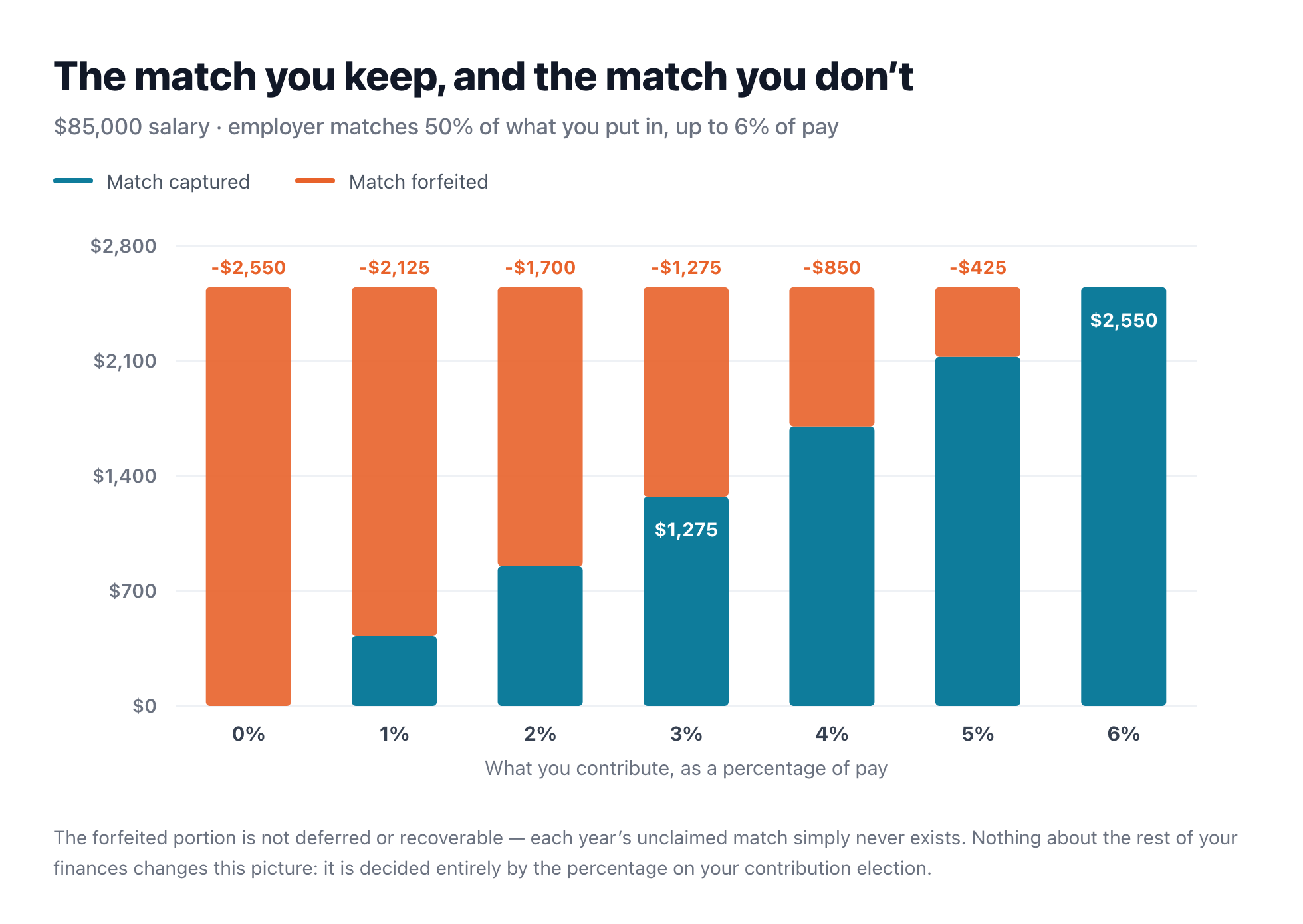
The line is straight, which is what makes this so unlike the rest of retirement planning. There is no optimum to find and no trade-off to weigh. Every percentage point you contribute below the match threshold forfeits a fixed number of dollars, and every point you add recovers them, until you hit the threshold and the effect stops entirely.
A household contributing 3% on that salary is declining $1,275 a year in pay they have already been offered.
Why the forfeited part is worse than it looks
$1,275 is not a large number on its own. Two things make it larger.
The first is that it does not roll forward. An unclaimed match is not deferred to next year or recoverable later — each year’s is simply never paid, and the year closes. It is the only expense in personal finance that is invisible on every statement you will ever receive, because it never happened.
The second is compounding. $1,275 a year, forgone for thirty years, at a 7% nominal return, is about $120,000. That is the real size of a 3% contribution election on an $85,000 salary with a 6% match available — not $1,275, but a six-figure hole that opens quietly at roughly $100 a month.
Nothing else in a retirement plan offers a guaranteed 50% return on the day you make it. Getting to the match threshold is not an investment decision; it is collecting pay you have already earned.
Four things to check on your own plan
- The two numbers in the formula. “100% up to 3%” and “50% up to 6%” are both worth 3% of salary, but they require completely different contributions from you — 3% in the first case, 6% in the second. Read which is which before setting your election.
- Vesting. The match may be yours immediately, or on a cliff, or graded over several years. It changes nothing about whether to capture it — unvested money still becomes yours if you stay — but it does belong in the calculation when you are weighing an offer to leave.
- Whether you front-load. If a match is calculated per pay period rather than annually, hitting the IRS limit in October can mean no contribution in November and December — and therefore no match in those months. Some plans have a “true-up” that corrects this; many do not.
- The IRS limit, which moves. The employee contribution limit is currently $24,500, with an additional $7,500 catch-up from age 50. The match ceiling and the IRS ceiling are unrelated numbers; you can hit one without approaching the other.
And what this doesn’t tell you
Capturing the match is the easy part of retirement saving, and it is worth being explicit that it is only the easy part. Whether 6% is enough is a different question with a much less certain answer, and it depends on your age, what you have already accumulated, and what you will be taxed on the way out.
Projections in this territory should also be read for what they are. The figures above are nominal — before inflation, before any tax on withdrawal. A 7% assumed return is a convention, not a promise, and thirty years of anything is a wide distribution rather than a line. What is not uncertain is the match itself: that part is contractual, and it is why this is the one retirement question worth acting on before you have thought about any of the others.
Or let it run itself
Teamint’s 401(k) Contribution Analysis takes your salary, your current election and your plan’s match formula and reports the match you are capturing, the match you are forfeiting, and the contribution percentage that closes the gap — along with the current IRS limit and your catch-up eligibility. Salary starts from the income already recorded in your household.
One thing to read carefully: its long-run projection compounds your contributions, not the employer’s. So treat the match figures as the answer to “what am I leaving behind this year” and the projection as a separate, more approximate question — the compounded value of the forfeited match is on top of what that line shows.
The 401(k) analysis sits on the paid plans rather than the free Starter tier. If you want to start with something free, your savings rate is the number that governs everything else, and it needs nothing typed in at all.
Check what you’re leaving behind
Start free, then upgrade when you want the full set. No bank login at any tier.
Contribution and catch-up limits are those configured in the product at the time of writing and change from year to year; confirm the current figures against IRS guidance and your own plan documents. Match formulas, vesting schedules and true-up provisions vary by employer — your plan summary is the authority, not this article. Growth figures assume a 7% nominal annual return, are not adjusted for inflation or for tax on withdrawal, and are illustrations rather than forecasts. Teamint runs calculations on figures you supply; it does not provide financial, tax, investment or retirement advice. See our Disclaimer.