The offer arrives as a single number, and the single number is almost always bigger. That is the whole problem. A 24% raise sounds like a decision that has already been made for you, right up until you notice that the new job is in a city where a two-bedroom costs $1,400 a month more, that you are giving up $3,000 of benefits, and that moving will cost you $12,000 before you unpack a box.
None of that means you should turn it down. It means the comparison you are being invited to make — old salary against new salary — is not the comparison that decides anything.
Compare total compensation, not salary
Salary is the part of your pay that is easiest to quote and easiest to compare, which is exactly why it gets quoted. The rest of it — employer retirement match, the share of health premiums they cover, paid leave you would otherwise have to buy back in unpaid days — routinely runs to 20–30% of what a job is actually worth to you, and it is invisible in the headline.
So the first move is to put both jobs on the same footing. Take an example: you earn $95,000 with benefits you value at $14,000, so your real number is $109,000. The offer is $118,000 with thinner benefits worth $11,000 — a real number of $129,000. On salary alone the raise is 24.2%. On total compensation it is 18.3%. The headline has already overstated the move by a third before anything else is counted.
Then adjust for where you’ll be spending it
A dollar is not worth a dollar everywhere. If the new city costs 18% more to live in, then $129,000 there buys what $109,322 buys where you are now — because the adjustment divides rather than subtracts. Against your current $109,000, that entire package is worth $322 more a year. The 24% raise has evaporated.
Which raises the question the calculator is actually good for: how big would the raise have to be to make the move worth taking at all?
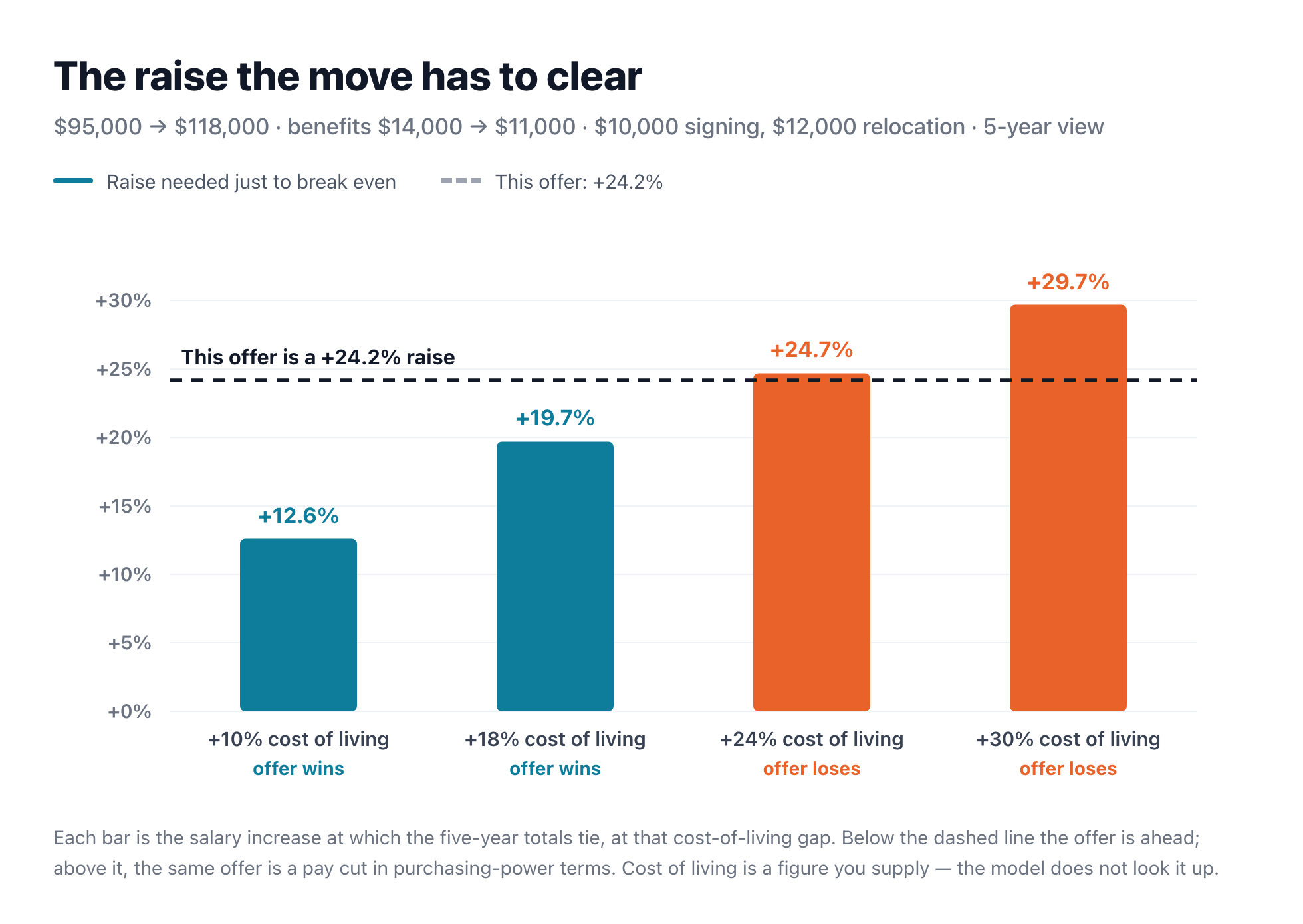
The pattern is worth committing to memory, because it is close to a rule: the raise has to roughly match the cost-of-living gap just to keep you level. A 10% more expensive city needs about a 12.6% raise. An 18% city needs 19.7%. A 24% city needs 24.7%. Slightly more than the gap, because the relocation cost has to be earned back too, but close enough that you can do it in your head while you are still on the phone.
A 24% raise into a 24% more expensive city is not a raise. It is the same job, in a different place, with a moving bill attached.
The first year is a different question from the fifth
Signing bonuses and relocation costs both land in year one and neither repeats, so they distort the first twelve months in opposite directions and then vanish. A $10,000 signing bonus against a $12,000 move is a net $2,000 headwind in year one and nothing at all thereafter.
That is why the useful output is a break-even point rather than a verdict. If year one comes out negative but the ongoing advantage is positive, the only real question is how many months you need to stay for the move to have paid for itself — and whether that number is shorter than how long you actually expect to be there.
Four things the arithmetic won’t tell you
- Neither salary grows. The model holds both flat for the whole horizon. Real careers do not work that way, and a new job often resets the raise clock — sometimes upward, sometimes by putting you at the bottom of a new band. If you have good reason to think the two paths have different trajectories, the comparison understates whichever one was going to accelerate.
- There is no tax in it. Everything here is gross. Moving between a state with income tax and one without can be worth several percentage points on its own, in either direction, and none of it shows up in this comparison. If you are crossing a state line, price that separately.
- The cost-of-living figure is yours to supply. Nothing looks it up for you. Published city-to-city indices vary enormously depending on what they weight, so use one you can name, and treat a 5-point difference between sources as a reason to run it twice rather than a rounding error.
- Unvested money is real money. Equity that has not cliffed, an employer match still inside its vesting schedule, a bonus that pays in March if you are still there — all of it is forfeited on the way out, and none of it is in the headline number either.
Running it yourself
- Build both total-compensation numbers. Salary plus a defensible value for benefits. Be consistent across the two — the error only matters if it is bigger on one side than the other.
- Divide the new one by the cost-of-living multiplier. 18% more expensive means dividing by 1.18, not subtracting 18%. Subtracting flatters the move.
- Handle year one separately — add the signing bonus, subtract relocation — then run the remaining years at the adjusted figure.
- Compare the totals over the horizon you actually believe. Five years is conventional. If you would honestly be looking again in two, run two, and watch how much of the advantage was sitting in years four and five.
Or let it run itself
Teamint’s Career & Income Decision analysis does this comparison end to end: total compensation on both sides, the cost-of-living adjustment, the signing bonus and relocation netted into year one, the cumulative difference over your chosen horizon, and the break-even month if the first year comes out behind. Your current salary starts from the income already recorded in your household; the offer you type in.
It reports the losing case as plainly as the winning one, which is the point — a number that only ever agrees with the exciting option is not much use on a phone call with a recruiter.
It’s one of the ten Decision Lab analyses on the free Starter plan, so it costs nothing to run, and there’s no bank connection to set up — you enter your own numbers. If you also want to know whether the offer is a good one in absolute terms rather than just better than what you have, the Salary Benchmark answers that separately.
Price the offer properly
Free for households of up to two people. No credit card, no bank login.
All figures are outputs of the comparison described above, run on the example offer named in the text; they illustrate the method rather than any particular market. Cost-of-living percentages are supplied by the user, not looked up. The comparison is before tax and does not model salary growth, equity vesting, or state income tax differences. Teamint runs calculations on figures you supply; it does not provide financial, career, tax or legal advice. See our Disclaimer.