There are two well-known ways to pay off several debts at once, they disagree with each other, and each has a constituency that will tell you the other one is a mistake. The avalanche says attack the highest interest rate. The snowball says clear the smallest balance. What almost nobody tells you is how much money is actually riding on the answer — which is the only thing that makes the argument worth having.
It is usually less than the argument’s volume suggests. And it shrinks, quite sharply, the more you are able to put toward the debt.
Two orders, one pot of money
Both methods do the same three things. You pay the minimum on everything. You throw every spare dollar at one chosen debt. When that debt dies, its whole payment rolls into the next one, so the amount you attack with grows each time an account closes. That rolling payment is the engine, and it is identical in both plans.
The only difference is which debt you choose first.
- Avalanche orders by interest rate, highest first. This is arithmetically optimal: it always pays the least total interest, because it kills the most expensive money first.
- Snowball orders by balance, smallest first. It closes accounts sooner, which is the point — it trades some interest for the experience of finishing things.
Note that these two often agree. If your smallest balance also happens to carry your highest rate — a common shape, because small angry balances are usually credit cards — the two orderings are the same list and there is nothing to decide. The question only exists when your priciest debt is not your smallest.
What the difference actually costs
Take a household with $33,000 spread across three debts, deliberately arranged so the two methods disagree: a $3,000 store card at 6%, a $12,000 credit card at 24.99%, and an $18,000 car loan at 7.4%. Avalanche starts with the credit card. Snowball starts with the store card.
At $900 a month, avalanche clears the whole thing in 47 months having paid $8,243 in interest. Snowball takes 48 months and pays $9,739. The avalanche is better by $1,496 and one month.
That is a real amount of money and it is worth having. But watch what happens to it as the monthly budget changes.
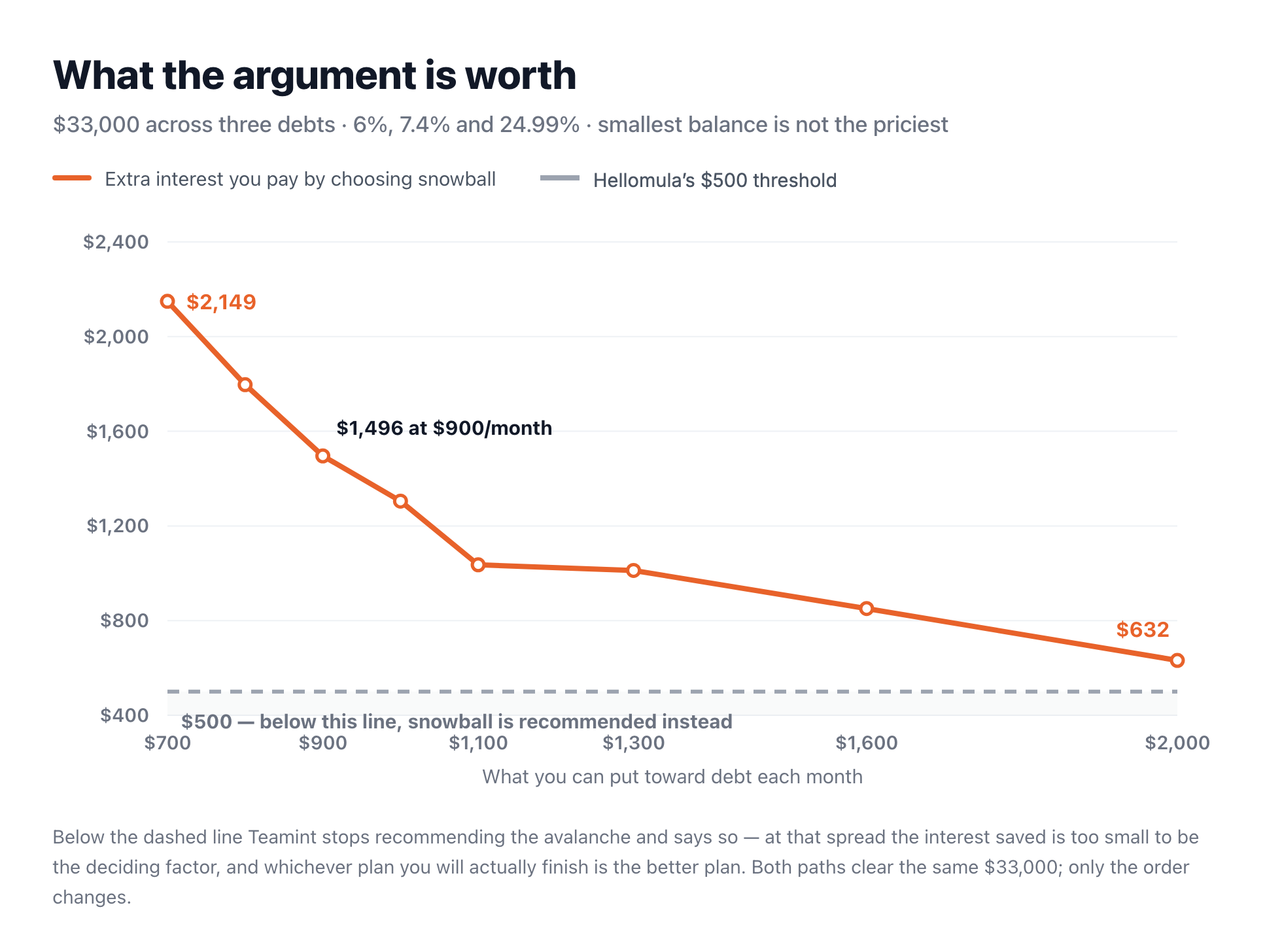
At $700 a month the ordering is worth $2,149. At $2,000 a month it is worth $632. Same debts, same rates, same two strategies — and the cost of choosing the “wrong” one has fallen by more than two thirds.
The reason is straightforward once you see it. Interest is a function of time and balance. When you are paying quickly, there is less of both, so there is less for the ordering to be right or wrong about. The avalanche’s advantage is largest exactly when you are most stretched — which is also, inconveniently, when a long plan is hardest to stick to.
The avalanche always wins on paper. The useful question is by how much — because a plan you abandon in month nine loses to a slightly worse plan you finish.
Where the math stops being the argument
Most calculators hand you the avalanche answer and stop, on the grounds that it is mathematically correct. It is. But “correct” and “decisive” are different claims, and a $150 difference over four years is not a reason to override how a household actually behaves.
Teamint draws that line at $500. Above it, the avalanche is reported as the recommendation with the interest saving named. Below it, the tool says the difference is small and that the momentum of closing accounts is a legitimate thing to weigh instead. It is a blunt threshold and it is visible in the chart above as the dashed line — the point at which the arithmetic stops being the interesting part of the decision.
Whether $500 is the right place for that line is a fair thing to argue about. What matters is that some such line exists, and that you know which side of it you are on before you pick a plan.
Four assumptions worth knowing about
Any payoff projection is a simulation, and this one makes four simplifications you should have in view before you lean on the output.
- It models three debts. If you have seven, group them — combine the cards into one line at their weighted average rate. The shape of the answer survives grouping; the exact month count does not.
- Minimum payments are assumed, not entered. The model uses 2% of the balance or $25, whichever is larger — so $60 on that $3,000 store card, $240 on the $12,000 credit card, $360 on the car. Your actual minimums, particularly on an instalment loan with a fixed payment, will differ. If yours are materially higher, your real timeline is faster than the projection and the ordering matters slightly less.
- A 0% debt is ignored entirely. Only debts with a rate above zero enter the calculation, so a promotional balance transfer or an interest-free medical plan drops out of the projection rather than being paid off inside it. That is defensible for interest math and wrong for cash flow — you are still writing that cheque every month. Add it to the “other debts” side of your own budget rather than expecting to see it here.
- Your budget has to cover the minimums. In the example above they total $660, so a $700 budget leaves just $40 doing the actual work. Enter a figure below the sum of your minimums and the projection has nowhere to go: balances grow faster than payments and the model reports a payoff time measured in decades. That output is a signal, not a plan — it means the shape of the problem is different, and consolidation or a hardship programme is the conversation rather than which debt to order first.
Running it yourself
You can do a version of this on paper in an afternoon, and it is worth doing once so the mechanism stops being abstract.
- List each debt with its balance and its rate. The rate is the part people skip, and it is the entire basis of one of the two strategies.
- Write down what you can put toward all of them each month — the total, minimums included. This single number drives the answer more than the ordering does.
- Order the list twice: once by rate descending, once by balance ascending. If the two lists match, you are done — there is no decision to make.
- Run each order month by month. Add interest at rate ÷ 12 on each balance, pay the minimums, put everything left on the debt at the top of that list, and roll the payment forward when one dies.
- Compare the two interest totals. That difference — not the strategies’ reputations — is what you are actually choosing between.
Or let it run itself
Teamint’s Debt Payoff Strategy analysis runs both simulations and shows them side by side: months to clear and total interest for each, the difference between them, and which side of the $500 line you fall on. The monthly budget starts from what your household already pays toward debt each month rather than an empty box; the balances and rates you enter yourself.
It does not hide the losing strategy, which is the part we think matters. Seeing the actual number next to the recommendation — $1,496 in the example above, but a few hundred in plenty of real cases — is what turns a doctrinal argument into a decision you can actually make — and in one of those two cases, the honest answer is that you should pick whichever plan you will still be following next spring.
It’s one of the ten Decision Lab analyses on the free Starter plan, so it costs nothing to run, and there’s no bank connection to set up — you enter your own numbers.
See what the ordering is worth to you
Free for households of up to two people. No credit card, no bank login.
All figures in this article are outputs of the projection described above, run on the example debts named in the text; they are illustrations of the method, not forecasts. Minimum payments, interest capitalisation and fees on your own accounts will differ from the model’s assumptions. Teamint runs calculations on figures you supply; it does not provide financial, credit, debt-counselling or legal advice. See our Disclaimer.