24 guided analyses across retirement, debt, housing, taxes, career, and financial freedom — powered entirely by the numbers you've already entered in HelloMula. No generic estimates. Real calculations from your real data.
Each module reads the accounts, transactions, and balances you've already entered and runs a focused analysis. You get a clear calculation — not a generic estimate.
Every analysis reads from the accounts, transactions, and balances you've entered — nothing extra to set up.
Browse by category — retirement, debt, housing, career — and open any module that matches your current question.
Results are saved so you can track how your numbers change over time — and household members can review analyses together in the household view.
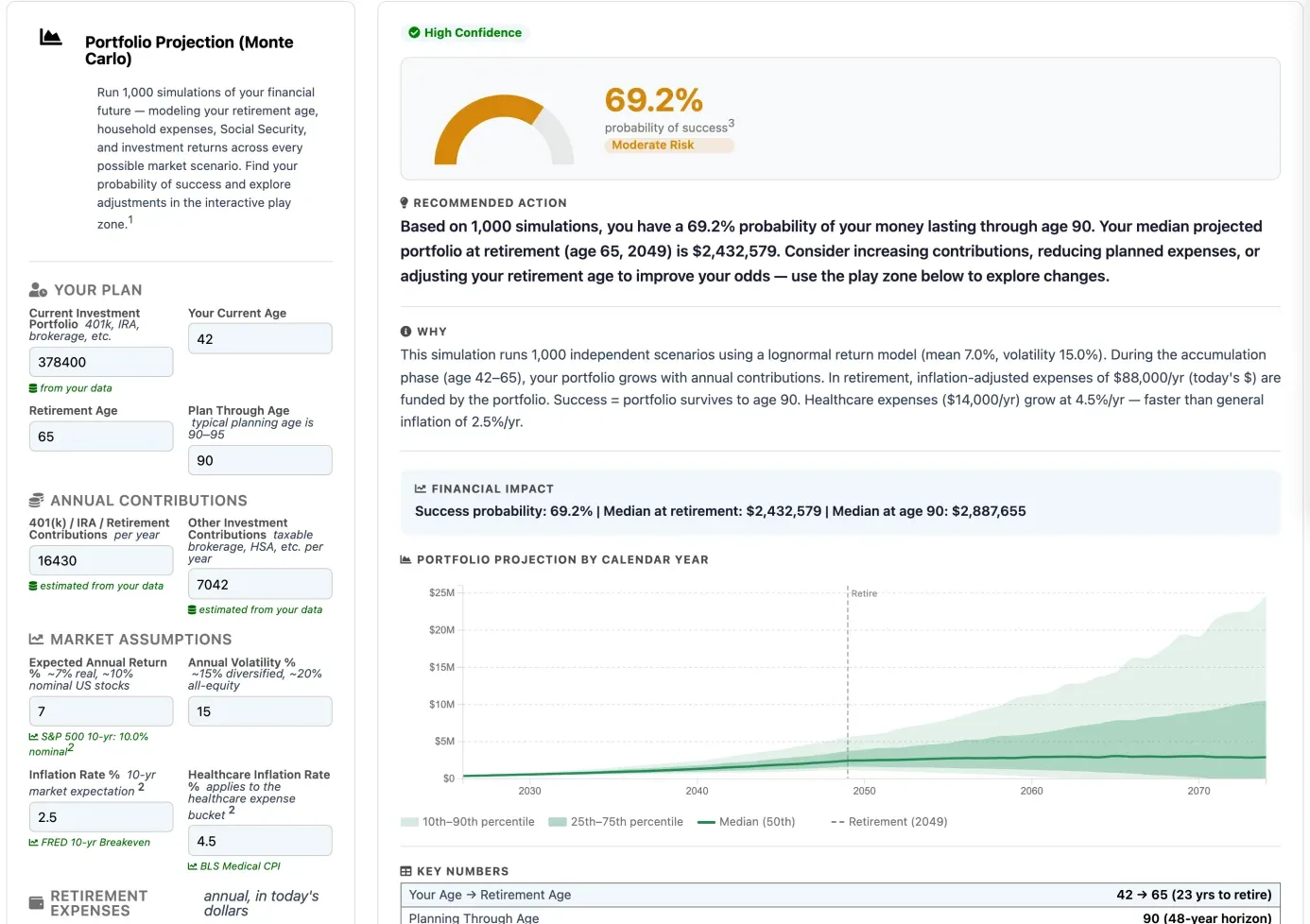
If your savings sit in a traditional 401(k), spending $80,000 means withdrawing considerably more than $80,000. HelloMula solves for that gross figure in every year of retirement — bracket by bracket, with Social Security taxed under the provisional-income rule — then runs 1,000 simulations and shows you the spread rather than one false-precision number. Adjust any assumption in the play zone and watch the probability move.
A composite picture of where your household stands right now.
A composite score across savings rate, debt load, spending habits, and goal progress. Know at a glance if your household is on track.
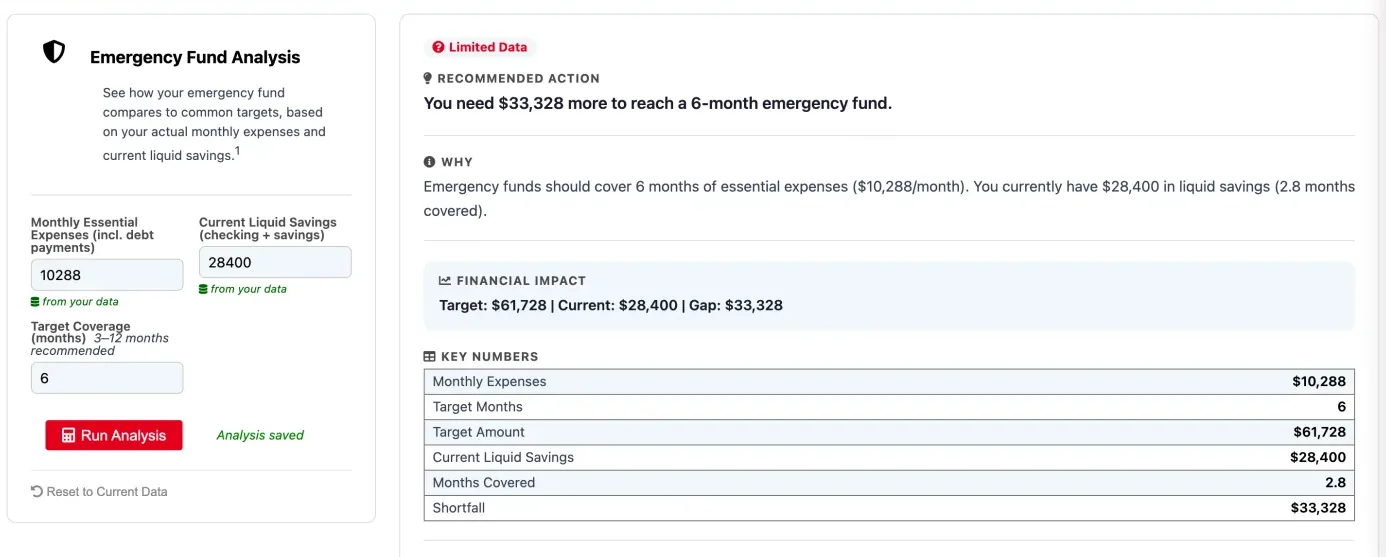
Are you saving enough — and is your safety net the right size?
Calculates exactly how large your emergency fund should be based on your real monthly expenses — not a generic "3-6 months" estimate.
How much of your income are you actually saving each month? Compared against common benchmarks for your income level.
Analyzes your actual cashflow and spending categories to show where you have room to grow your savings rate.
Analyzes your spending patterns to show specific areas where redirecting dollars could accelerate your savings goals.
From contribution modelling to a 1,000-scenario portfolio projection that carries federal tax through every withdrawal year.
Models how different contribution levels affect your projected retirement balance, based on your income, current savings, and projected retirement needs.
Models the tax impact and long-term balance difference of converting traditional retirement funds to Roth, using your actual account balances and income.
If you're over the Roth income limit, this module walks through the backdoor Roth mechanics and models the long-term numbers based on your income and account balances.
How much will you actually need in retirement? Calculated from your real spending history, not generic assumptions.
Based on your current savings trajectory, investment balances, and projected needs — when can you actually retire?
1,000 simulated market scenarios showing the probability your money lasts — with federal income tax on every withdrawal, your Social Security taxed under the provisional-income rule, and brackets indexed forward each year. Most projections debit the portfolio in pre-tax dollars and quietly overstate your odds. See how this is calculated.
Calculates your exact Required Minimum Distribution for any year, models a multi-year withdrawal schedule, and surfaces strategies — like QCDs and Roth conversions — to soften the tax impact.
When can you stop working by choice? These modules calculate your path to financial independence.
Calculates the exact date your passive income and savings will cover your expenses — your personal financial independence date.
Model scenarios: what if you increased savings by 10%? Changed spending? Got a raise? See how each change moves your FI date.
Stop guessing the fastest or cheapest way out of debt. These modules run the math on your actual balances and rates — so you can see exactly which approach costs less interest and gets you there faster.
Compares avalanche (highest interest first) vs. snowball (smallest balance first) methods using your actual debt balances. Shows payoff date and total interest for each.
How much would an extra $200/month shave off your mortgage? Models extra payment scenarios and shows the interest savings in dollars.
One of the biggest financial decisions you'll make — modeled with real numbers, not online calculator guesses.
A true apples-to-apples comparison of buying vs. renting that accounts for your current rent, home prices in your area, investment opportunity cost, and time horizon.
Based on your actual income, existing debts, and spending habits — what home price range can your household realistically afford?
Major life and financial decisions — modeled with your real numbers.
How much do you need to save per month to fund a child's college education? Models 529 growth and tuition inflation scenarios.
Compares your life, disability, and liability coverage levels against your household's financial obligations to show where gaps or overlaps may exist.
Comparing a job offer or career change? Models the full financial impact — salary, benefits, commute costs, and long-term trajectory.
Buy or lease? New or used? Models the 5-year total cost of ownership for any vehicle scenario based on your actual budget and driving needs.
Compares your income against national BLS wage data for your occupation. See your percentile, your distance from the median, 75th, and 90th percentiles, and what moves would close the gap.
Estimates your federal income tax, effective rate, and marginal rate from your income and filing status — with a full bracket breakdown, FICA taxes, and opportunities to lower your bill.
Plan availability: Ten analyses are on the free plan — every one tied to a decision you might be making right now, including mortgage payoff, house affordability, buy vs rent, the salary benchmark, a career change and college savings. The remaining fourteen, including the retirement projection and the federal tax estimator, are on the Household plan at $7.99 a month or $79 a year. See the full comparison →
Ten analyses free for households up to 2 members. No credit card required.
Household unlocks all 24 analyses, including the retirement projection and the federal tax estimator.